|
Mathematics is much more than finding sums, differences, products, and quotients. Mathematics is a way of looking at the world. As a mathematician, you view the world looking for regularity and order or the lack of order and regularity.
Rotational Symmetry is also know as Radial Symmetry 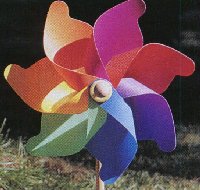
We are surrounded by all types of symmetry, a type of regularity and order--in nature, in architecture, in art and much more.
It is common to find objects with rotational symmetry.
A figure can be turned about a point less than 360 degrees and land on an image of itself is said to have rotational symmetry. Another way of thinking of rotational symmetry is seeing an image arranged in rays diverging from a single point. That point is called the center of rotation.
The pinwheel has rotational symmetry. The point in the middle of the pinwheel is the center of rotation. If you ignore the colors and focus only on the shape, the pinwheel has an order of 7 and magnitude of 360/7 or 51 3/7 degrees. The order is found by determining how many stops you can make while turning in a circle matching the original image (include the original position as one of the stops). The magnitude is found by dividing 360 degrees by the order.
For more information and activities about Rotational Symmetry, visit these pages.
[Pattern Blocks] [Hub Caps] [Activities] [Extensions] [Challenge] [Symmetry Home Page]
These symmetry pages have been brought to you by Nancy Powell, a TeachNet Web Mentor from Bloomington High School, Bloomington, IL.
|