|
About this Daily Classroom Special
Passion for Poetry presents a series of interactive worksheets designed to expose students to the world of poetry. The worksheets allow for differentiated activities so students at all levels can develop a passion for poetry. Passion for Poetry was written by Janice Gordon, Laptop Program Coordinator for Hartford (CT) Public Schools and a
former Teachers Network web mentor.
What is Haiku?
Haiku is a very short poetic form, consisting of three lines of 5, 7, and 5 syllables each, and must have a special word that evokes (brings to mind) the season. It is probably the shortest poetic form in the world, and its development is native to Japan, with no influence from either the West or China. The poet must be concise (brief), while concentrating deep spiritual understanding into the poem. The haiku poet usually takes up the changes of nature which have impressed him in order to express the intangible (unable to be defined or realized) world of the spirit.
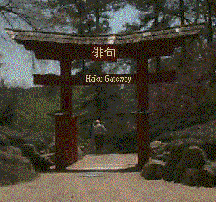 MATSUO
BASHO (1644 - 1694) was a leading haiku master and is known throughout
the world. Click on the Haiku Gateway to read more about Basho, then
answer the questions that follow. MATSUO
BASHO (1644 - 1694) was a leading haiku master and is known throughout
the world. Click on the Haiku Gateway to read more about Basho, then
answer the questions that follow.
Questions & Activities
- Choose one of Basho's poems. Count the number of syllables in
each line. Why do you think that they don't follow the number of
syllables that are supposed to be in a haiku? (Hint: What is Basho's
original language?)
- What inspired Basho to write his poetry? Give specific examples.
- Read about how to compose haiku poems. Although Haiku usually
has a certain form, not everyone can agree on how many syllables
should be in each line. What are the basic things that most haiku
writers do agree on?
- Try writing a haiku of your own.
Still can't get started on writing your own haiku? Click
here to jumpstart your haiku creation.
- Sometimes people like to break the traditional rules of haiku. Read
Non-traditional computer haiku. What syllable structure do most
of them follow? Did you enjoy the computer haiku? Why or why not?
- Write a non-traditional haiku of your own. Have fun!
|