Most of the medical card is completed by the
medical staff (nurse, nurse practitioner etc.). However
there are portions that need to be completed by the classroom
teacher. It is important that this information be current
and accurate.
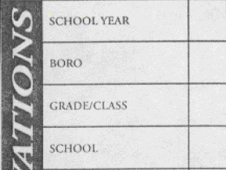
You would list the current
school year (2002/03).
You should insert the appropriate
borough code (K, Q, X, M, R).
This is your current class
designation (i.e. K-220).
This is your school number
(i.e. 124).
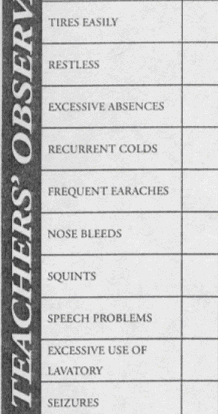
If you have observed
any of these behaviors, or are aware of any problems
(i.e. the child receives speech therapy or the parent
informs you that the child suffers from seizures)
you should place a check in the appropriate box.
If you have not observed any difficulties and are
unaware of any pre-existing conditions then you
should write "NSN" or "Not So Noted" straight down
the row of boxes.
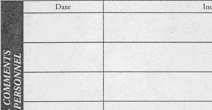
If a child is absent for a surgical
procedure (i.e. tonsillectomy) or has been diagnosed
while in your class you should note the information
in this section. You should mark the dates of the
absences (10/14/03 - 10/28/03) and the reason (tonsillectomy).
You must also sign your name and title next to the
entry.
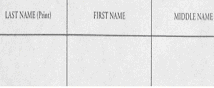
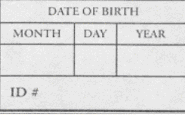
The student's name, birth
date and ID number are written on the front of the
medical card.
However, in order to avoid future confusion you
should take a few minutes to fill in the same information
on the inside section of the card.
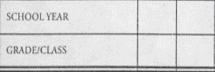
The school year and grade
designation should be entered in this section.
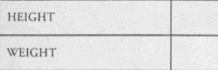
In some schools this is completed
by the medical staff. Early grade teachers generally
complete this section themselves. Some teachers,
especially upper grade teachers, send a survey home
with each child requesting the information from
the parents.
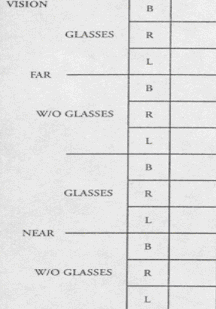
If your school does not
have a procedure to complete vision testing for
the students, you should borrow an eye chart from
the medical office. In order to check the far vision
you need to mark off a spot 20 feet from the eye
chart. The side of the eye chart has numbers beside
each line. It is advisable to start at level 20.
Have each student cover first one eye, then the
other and read the line. Then have the student read
the line with both eyes. If a student can read line
20 then there is no need to test further - the student
has 20/20 vision. If the student cannot read that
line, then progressively move up the chart until
the student is able to read a line with fewer than
2 errors. That is the student's far vision (i.e.
20/30).
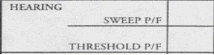
Hearing tests are administered by
personnel other than the classroom teacher. You
should receive a list of your students' results
(Pass or Fail). Indicate the results in the box
with a "P" or an "F."
When a student returns a dental form,
which has been completed by a dentist, you should
indicate this by placing a check in the box.
Come across an outdated link?
Please visit The Wayback Machine to find what you are looking for.