| Darwin's
Evolution
Project URL:
http://teachersnetwork.org/teachnet-lab/fklane/aanderson/darwin.html
How it works:
This unit deals with the Father of Evolution,
his theories and the impact they have on us today. In this unit students
will have the opportunity to see a well-crafted video on Darwin.
This video is informative and only 30 minutes long. You feel for Darwin as he tries to find purpose to his life after
the death of his beloved mother. It covers his life, voyage on the H.M.S. Beagle, formulation
of his theories and their consequences on the world.
The students will also experience the Internet.
They will be brought to sites full of interesting information where
insight can be obtained and synthesized through PowerPoint work, as
well as formal presentations. Creationism is brought out
to balance Darwin’s Theories. It is current and apropos in a country
of such diversity. Modern Theories will be seen with an in-class
lab using the Hardy-Weinberg Law which refuted spontaneous generation.
This adds reality by using the Scientific Method. The teacher
may want to use only one or all of these lesson plans.
The concluding plan asks: "Life – How did it
get here?" then proceeds to review, at the same time
providing students the opportunity to explore Internet sites of interest
on the topic.
Standards addressed:
The science standards for grades 9 through 12 are addressed and
shown in the first lesson plan entitled: "Darwin’s Evolution."
They range from New York State Performance Indicators 3.1 to 3.5.
Software/Materials needed:
You will need the use of a television and
vcr, the video “Evolution’s Voice,” PowerPoint and/or Clarisworks software,
and Internet access.
Recommended: Biology The Study of Life by Prentice Hall, 1991
or similar student text
The students:
These are young people from all walks of life, from the four
corners of the globe. There are students who have just arrived
from their home countries and want to get an education, students
from the projects and students from urban Queens. Franklin K.
Lane is an inner city school with an inner city population.
Overall value:
This unit has something for everybody. There is a video
to get your students’ attention (its only 30 minutes long) entitled
“Evolution’s Voice.” There are Internet sites to help teacher
and student alike research information on Evolution, Modern Theories,
and future prospects. An in-class lab to bring evolution into
your classroom is also there. Presentation and PowerPoint work
are an added form of enrichment. Another plus can be publishing your student’s work on the web.
Tips:
When
you use the video “Evolution’s Voice” make sure you have your students
take notes and ask questions. Their
finished projects can be posted on the Internet as an added perk for
this unit. You’d be surprised
how self-esteem soars when students see their work on the web.
|
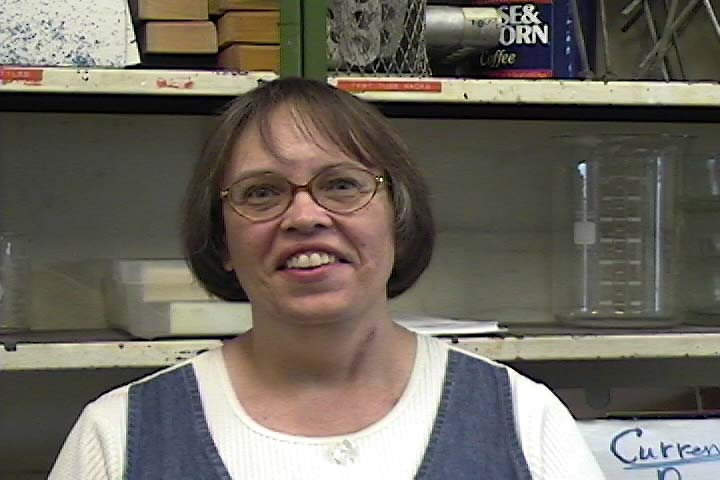
Mrs. Amelia Anderson, a new teacher
in the public school system, has taught for three years in the inner
city school Franklin Knight Lane High School. She is presently
the Director of Science Research and teaches Bilingual Biology, Environmental
Science, Earth Science and Authentic Science Research. This teacher
uses whatever it takes to get students to learn. With a little
of this and a little that she makes up her lesson plans. If you’d
like to see what she has cooked up visit her website at: http://teachersnetwork.org/teachnet-lab/fklane/aanderson
E-mail Contact: AmeliaAnd@aol.com
Estimated number of class periods: seven class periods of 50 minutes each
Subject area: Biology, Living Environment
Beginning grade level: 9
Ending grade level: 10
|