Cave Painting in the I.C.E.
Age
Project URL:
http://teachersnetwork.org/teachnet-lab/meisler/caveindex.htm
How it works:
In this unit, introduced in Humanities
class with online research in the digital art computer lab, students
explore early human cave paintings in order to create their own faux cave
paintings. An Early Humans task sheet guides them through a variety of
rich Web sites covering cave paintings in France, Spain, and India as well
as artifacts and digs in the U.S. Upon completion of the Internet
research, the students use charcoal sticks and chalk to sketch in the
elements for their own paintings on brown paper bags. They then use
watercolors in a palette of black, browns, ochre, and sienna to resemble
ancient cave paintings. After drying, the 21st century cave paintings are
exhibited on the classroom bulletin boards. Classmates take turns
interpreting each another's work. This program was first created for sixth
grade students at the Institute for Collaborative Education
(I.C.E.), a small, diverse New York City public school for grades six
through twelve.
Standards addressed:
Students
understand the historical perspective and the biological and cultural
processes that shaped the earliest human communities, and view the past in
terms of the norms and values of the time. They apply media, techniques,
and processes related to the visual arts; know a range of subject
matter, symbols, and potential ideas; and understand the visual arts in
relation to history and cultures. They study the biological and
cultural processes that shaped the earliest human communities, and use
content, style, and structure (formal or informal language, genre,
organization) appropriate for specific audiences (public, private) and
purposes (to entertain, to influence, to inform).
Materials
used:
Required materials include computers with Internet
connection, an Early Humans
worksheet, pencils, scrap paper, brown paper bags, chalk, charcoal,
watercolors, brushes, and water.
The students:
This program was created for sixth
grade students, but it can easily be adapted for other grades.
Overall value:
Cave Painting in the I.C.E.
Age is a hands-on approach to recreating the visual iconography
used by early humans to record their daily lives and hunts. Through the
Internet, students explore archaeological sites where cave paintings have
been discovered. At I.C.E., it has been found effective to integrate
learning in more than one classroom. While the students learn about early
humans in humanities class, their interest becomes impassioned as they do
Internet research and then return energized and ready to create their own
faux cave art.
Tips:
During Internet research time, tell the
students that they can work as individuals or in teams as long as each
student is responsible for filling out his/her own work sheet. Some
students might require additional time to complete the sheet. If time
isn't available in the lab (or if you don't want to extend the time
allotted), let them finish it for homework. If a student does not have an
Internet connection at home, he/she can stay after school or go to the
public library. At. I.C.E., three different classes did this
project. The students were shown how to bookmark the sites to make it
easier for the next class to find.
|
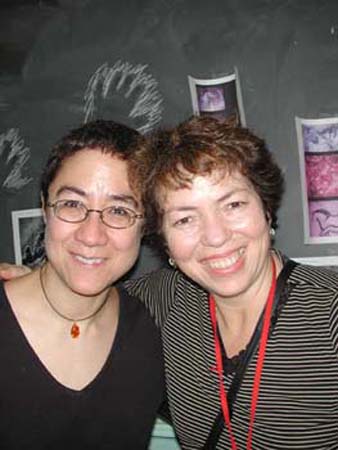
About the teachers:
Meryl Meisler and Grace
Raffaele are colleagues working with the middle school students at the
Institute for
Collaborative Education. Meryl teaches digital art and
Grace teaches humanities. They like to collaborate on units that involve
both curricula.
E-mail:
merylatice@yahoo.com
graceatice@nyc.rr.com
Subject
Areas:
Social Studies
Arts
Technology
Grade Level:
6-9
|