Composition
Compositions
Project
URL: http://teachersnetwork.org/teachnet-lab/meisler/composition.htm
How it works:
Students use the Internet to explore
the theory of composition in visual art. They explore the relevance of
symmetry, asymmetry, and balance by viewing well-known works of art online
and interacting with sites where art principles are animated. The
students' task is to sketch a composition of at least five elements and
use the drawing and painting tools of Macromedia Flash to recreate it. An
animation of at least 30 frames is planned; students write compositions
about their animated compositions and assemble the final digital media
piece in simple web pages. A virtual gallery is displayed
here:
www.thebleedingedge.org/features/compose_9/compose_toc.html
Standards
addressed:
Students understand and apply media,
techniques, and processes related to the visual arts; know a range of
subject matter, symbols, and potential ideas in the visual arts; and learn
how to use structures (e.g., sensory qualities, organizational principles,
expressive features) and functions of art. They employ the general skills,
strategies, and grammatical and mechanical conventions of the writing
process, and use viewing skills and strategies to understand and interpret
visual media.
Materials used:
This program requires a networked
Macintosh lab with Internet connection, Macromedia Flash, Microsoft Word,
and Dreamweaver software.
The students:
The ninth grade digital art students at
the Institute for Collaborative Education, a small 6-12th grade NYC public
school, are heterogeneously mixed with a wide range of art, technical, and
writing skills.
Overall value:
The web links for Composition Compositions are full of interesting things that
spark each student's artistic eye. There are virtual hands-on examples of
composition they can "play around" with. Anyone can feel successful at
this project, even if they "can't draw," because the compositions can
consist of abstract shapes. The program can easily be adapted to any
level, grades 5 and up. Once the students become aware of symmetrical and
asymmetrical composition, they see it everywhere they go. Animation
captures the imagination of students as they explore this diverse
subject.
Tips:
You can use any animation program, such
as ImageReady, or create animated gifs to do this project. The kids can
write a composition first, and then plan a visual or vice versa. The
students can work in teams; one can write the poem while the other does
the visual.
|
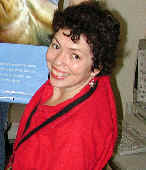
About the teacher:
Meryl Meisler, digital
art teacher at the Institute for Collaborative Education, began teaching
in 1979. She has received a Disney American Teacher Award in visual arts,
serves on the Teachers Network Board of Directors, and is a consultant to
the Whitney Museum's online learning department. Meryl is an accomplished
artist in her own right.
E-mail:
Merylatice@yahoo.com
Subject
Areas:
Arts
Language
Arts
Technology
Grade Levels:
5-12
|