The Creative Process
Project URL: http://teachersnetwork.org/teachnet-lab/meisler/creative_process.htm
How
it works:
The Creative Process was introduced at I.C.E. as the first unit of the school year in art class. It can also be introduced in an English class. Students are lead, step by step, through the creative process using a creative writing assignment as the vehicle. They focus on how to come up with an initial idea, how to refine and flesh out the idea, and how to express meaning. This same process is then applied to making a visual work of art using collage as the medium, or creating a Web-based project. Students will produce a one to two page finished piece of creative writing and a finished collage or Web-based project that includes their writing and accompanying visuals.
Standards addressed:
Visual Arts
- Students conceive and create works of visual art that demonstrate an understanding of how the communication of their ideas relates to the media, techniques, and processes they use.
- Students initiate, define, and solve challenging visual arts problems independently using intellectual skills such as analysis, synthesis, and evaluation
.
- Students compare the materials, technologies, media, and processes of the visual arts with those of other arts disciplines as they are used in creation and types of analysis.
- Students synthesize the creative and analytical principles and techniques of the visual arts and selected other arts disciplines, the humanities, or the sciences.
- Students correlate responses to works of visual art with various techniques for communicating meanings, ideas, attitudes, views, and intentions.
Language Arts:
- Students apply a wide range of strategies to comprehend, interpret, evaluate, and appreciate texts. They draw on their prior experience, their interactions with other readers and writers, their knowledge of word meaning and of other texts, their word identification strategies, and their understanding of textual features (e.g., sound-letter correspondence, sentence structure, context, graphics).
- Students adjust their use of spoken, written, and visual language (e.g., conventions, style, vocabulary) to communicate effectively with a variety of audiences and for different purposes.
- Students employ a wide range of strategies as they write and use different writing process elements appropriately to communicate with different audiences for a variety of purposes.
Materials used:
Pencils, writing paper, blank drawing paper, networked Macintosh computers with Internet connection, Photoshop, Imageready, Flash, Dreamweaver, Microsoft Word.
For non-digital project (mixed media collage): scissors, glue stick, markers, colored pencils, water color.
The
students:
This program was created for ninth
grade students at the Institute for Collaborative Education,
a small, diverse, New York City public school for grades six through
twelve. The project can be done with higher levels as well, with a different degree of sophistication.
Overall value:
Students will understand that the creative process is something that they all have the ability to engage in and that this process is useful in all subjects, not just art. They will see how this process involves using their imaginations, critical thinking skills, problem solving skills, a strong work ethic and their ability to reflect on their finished product.
Students learn to trust their own intuition and instincts during the creative process; capturing their thought processes as they are happening, putting them in writing and then visualizing their ideas. There are no right and wrong answers when it comes to creativity; grammar and spelling revisions come after their first drafts, rough sketches are the formation for finished pieces. The process of coming up with ideas, and the courage to follow through with action, production and exhibition/sharing is a model they can use for art, writing, and numerous creative and practical decisions throughout life.
Tips:
Related web sites and articles on The Creative Process:
Seven Stages of the Creative Process
http://mgtaylor.com/mgtaylor/glasbead/7stagcrp.htm
Creativity and Inspiration: Stages of the Creative Process
http://artlex.com/ArtLex/c/creativity.html
Directed Creativity model
http://directedcreativity.com/pages/WPModels.html
Developing your own Process of Creativity
http://howdesign.com/dc/features/creativeprocess.asp
Right Brain VS Left Brain and the Creative Process
http://alistapart.com/articles/creative/
Breaking Through: The Creative Engineer
http://eweek.org/site/nbm/intro.html
|
About the teachers:
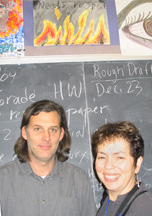
Meryl Meisler and Paul Nowell are art teachers, and colleagues at the Institute for Collaborative Education in NYC. Paul teaches “hands-on physical” art and Meryl teaches “hands-on digital” art. The Creative Process unit was introduced and adapted for both use with physical and/or digital art mediums.
E-mail: merylatice@yahoo.com
Subject
Areas:
Art, Language Arts
Grade
Levels: 9-12
|