Totem
Transformations
Project URL: Totem Transformations
How
it works:
The unit
is introduced in the Humanities class, as students learn about the origins
of Totems in Native American folklore. In the computer lab, students
read Totem stories and explore the meaning and symbolism behind the
myths using various Web sites. Students write their own myth
and poems describing how each of them found their own totem anima. While
writing and editing their stories and poetry in Humanities, the students
are using their time in art class learning how to draw representational
self-portraits using guidelines and proportion. The students transform
their drawings into digital images and manipulate them using ImageReady
software. They continue using layers to make an image that is part human,
part totem. The results, along with their writing, are presented on
Web pages.
Standards addressed:
Visual
Arts:
- Understands
and applies media, techniques, and processes related to the visual
arts
- Knows
a range of subject matter, symbols, and potential ideas in the visual
arts
- Understands
the visual arts in relation to history and cultures
World
History Standards:
- Understands
the biological and cultural processes that shaped the earliest human
communities
- Knows
how to view the past in terms of the norms and values of the time
Language Arts:
- Uses content,
style, and structure (e.g. formal or informal language, genre, organization)
appropriate for specific audiences and purposes (to entertain, to
influence, to inform)
Materials used:
Pencils, writing paper, blank drawing
paper, networked Macintosh computers with Internet connection, Photoshop,
Imageready, Dreamweaver, Microsoft Word
The
students:
This program was created for sixth grade students enrolled in Humanities
and Digital Art classes the Institute for Collaborative Education, a
small, diverse, New York City public school for grades six through twelve.
Overall value:
Totem Transformations made each student
feel successful. Native American folklore motivated each student to
write his or her own folklore and poetry. Using proportion and guidelines,
each student saw portraiture drawing skills improve tremendously. They
joyfully animated their self-portraits into their individual totems,
bringing their stories and poems to life.
Tips:
At first, most kids (most people) are terrified at the thought of
drawing people. “I can’t” becomes “I will try” as you go through the
step-by-step method using guidelines. If a kid becomes “stuck” while
drawing or animating, let them switch back and forth with formatting
the text and layout of their writing. Let the more experienced animators
help their classmates; the enthusiasm is catching.
At I.C.E., we find it effective to integrate learning by teachers collaborating
on projects. The students use multiple perspectives and tackle problems
with a variety of means, methods and mediums.
|
About
the teachers:
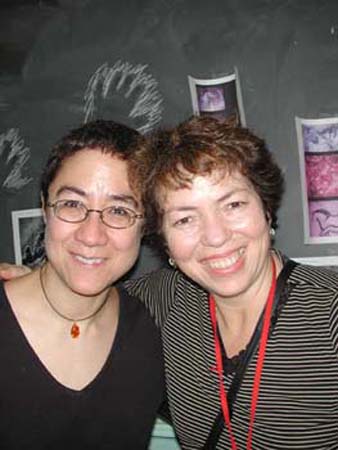
Meryl
Meisler and Grace Raffaele are colleagues working with the middle school
students at the Institute for Collaborative Education in NYC. Meryl
teaches Digital Art and Grace teaches Humanities. They like to collaborate
on units that involve both curricula.
E-mail:
merylart@earthlink.net and graceatice@yahoo.com
Subject
Areas:
Visual Arts, Humanities, History, Creative Writing
Grade
Levels: 6-12
|