Invisible
Workers
How
it works:
New York is known as "the city that never sleeps." There are people at work at any hour of the day, 7 days a week, 52
weeks a year. Many are "invisible," working behind the
scenes in unusual places and situations. Their efforts are often not
readily recognized or appreciated. Invisible Workers gives
students insight into the under-appreciated people whose jobs affect
our everyday lives. The students interview people who work in a
variety of fields and learn about the requirements, opportunities, and
unique characteristics of their jobs. As preparation, they brainstorm what they think the expression "invisible
worker" might mean. Then they go to one of the following suggested
sites to learn more about invisible workers:
Justice for Janitors, a national
campaign of the Service Employees International
(http://hr.monster.com/articles/workers/), and Invisible Workers, Hidden Abuses: A Call to Fast for New York's
Working Poor (http://nysut.org/media/releases/
20010321laborfast.html).
While looking at the sites, they list at least four types of
jobs that might be "invisible" and consider some of the
disadvantages about working in an "invisible job." The class
discusses jobs that are under-appreciated (clerk, housewife, teacher,
anonymous authors) and students write pre-planned questions (beginning
with the words "Who," "What," "When,"
"Where," and "How") for oral interviews with an
"invisible worker" of their choice. After school, the students conduct their interviews and
write the answers in their notebook. For homework,
they write a first draft of their invisible worker story, based on the
interview. The first drafts are shared in class; each student takes a turn reading
a classmate's story. In teams, students check each
other's work for spelling and grammar, and give positive critical feedback.
The first drafts are revised for homework and the teacher edits the
second draft. Final drafts are word processed for use as a web
project. The students plan their visuals with pencil and paper. The
drawings include an icon to represent their work, a portrait of the
worker, a title page, and an illustration of the person at their job,
and use a drawing software program (such as PhotoShop or AppleWorks). The students use html or a
web-authoring program such Dreamweaver to create their web pages.
Standards addressed:
Students interpret and analyze information from oral interviews; relate new information to prior
knowledge and experience; distinguish between relevant and irrelevant
information and between fact and opinion; and understand and use the
text features that make information accessible and usable, such as
format, sequence, level of diction, and relevance of details. They
develop information with appropriate supporting material such as facts
or anecdotes and exclude
extraneous material; use the process of pre-writing, drafting,
revising, and proofreading to
produce well-constructed informational texts; recognize different
levels of meaning; and write stories that observe the conventions of
the genre and contain interesting and effective language and voice.
Materials used:
Required materials include a computer with Internet access, word
processing software (SimpleText, Microsoft Word or AppleWorks),
drawing software (AppleWorks, CorelDraw, or PhotoShop), and raw html or
html editing software (Dreamweaver, GoLive, or PageMill). A scanner is optional.
The
students:
Invisible Workers was created by seventh grade digital art
students at the Institute for Collaborative Education. The students
are grouped heterogeneously and have a varying skill and ability
levels. The program was begun in the last cycle of the school year; the
students were already familiar working with word processing, drawing,
and html editing software. This was their year-end final project that
encompassed all the skills they had learned in the year.
Overall value:
This program gives students insight into the working world. They
learn through Internet research, and by conducting oral and written
interviews, the similarities/differences, advantages/disadvantages,
requirements, challenges, and rewards of different jobs. The
students gain some understanding of the importance of worker benefits such
as healthcare, job security, and opportunities for advancement. Using
traditional and new media, they create web pages based on their
research.
Tips:
Encourage students to learn more about the work of people who are a
part of their everyday lives, such as their family and friends or
people at local businesses. You might create an introductory letter
for students who wants to interview a person they are reluctant to
approach. If a student doesn't want to interview a "real"
person, then give him/her the option of interviewing an imaginary one,
as long as it is based on actual research about that
specific job. You can link this project with any Career Day, Job Fair,
or other activities your school community might be
involved with.
|
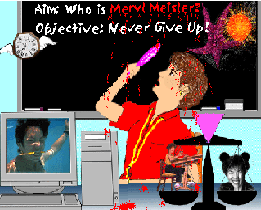
About the teacher:
Meryl Meisler has taught in New York City since 1979. She works by
day as
a digital art teacher, and by night and weekend as a professional
artist who does not want to be invisible.
E-mail:
meryl@teachersnetwork.org
Subject
Areas:
English
Technology
Grade
Levels:
7-12
|