Flower Power
How it works:
This hands-on unit takes a discovery approach to the understanding of
flowers, their structures, how they reproduce, how they are classified, and
what conditions their seeds thrive in. This unit is aimed towards the upper
elementary grades (3-6) and should be conducted during late May into June
since most of the activities require the accessibility of flower specimens
that bloom this time of year for observations. As a result of this unit,
students will be able to name and locate flower structures, classify flowers
through observation of their structures, understand and appreciate the
importance of the pollination and fertilization process, and discover the
environmental conditions which affect the growth of plants. Students will
also be using different kinds of resources for exploration such as the
computer and the Internet. The teacher will be responsible for teaching
students how to use the these resources before conducting the unit. It is
also recommended that before a unit is started, that the teacher needs to gauge the knowledge
students
already have about the subject, what they want to know and what they learned
through a discussion with the students as an introduction to the unit.
Their responses should be charted on a KWL graphic organizer and displayed
in the classroom. As for the assessment piece, students will be collecting
observations work in a folder as well as keeping notes of what they learned
in a science journal. Note that the science journal is a place for students
to keep questions as well as observations. Reading them periodically will
not only assess what they know, but also what their interests on the subject
are.
Standards Addressed by This Unit:
New York State's Learning Standards being addressed in this unit are that
students will
- Use scientific inquiry to pose questions, seek answers, and develop solutions.
- Access, generate, process, and transfer information using appropriate technologies.
- Understand and apply scientific concepts, principles, and theories pertaining to the physical setting and living
environment and recognize the historical development of ideas in science.
- Apply technological knowledge and skills to design, construct, use, and evaluate products and systems to satisfy human and environmental needs.
- Understand the relationships and common themes that connect science and technology and apply the themes to these and other areas of learning.
- Apply the knowledge and thinking skills of science and technology to address real-life problems and make informed decisions.
Software Materials Used:
The computer, the Internet, digital camera, scanner, videotapes, computer software such as AppleWorks (Word Processing, Spreadsheet, Draw)
Students:
This unit is targeting students in upper elementary grades (3-6) who has
some skills to do research work on the Internet. Students should also have
some knowledge to use computer software to write journals, make charts, and
draw pictures and designs.
Overall:
This is a hands-on science study that uses a discovery approach to
understand the subject of study - flowers. Students will utilize the
Internet as an important resource to explore, discover, confirm, and
implement their studies. They will also be introduced to the use of digital
camera and the scanner to create and compile their portfolio.
Tips:
At the start of the project, have a session to find out what students
already know and what they would like to know more about the subject. Chart
the findings and display in the classroom as reference throughout the unit
of study. Require students to keep study journals and portfolio folders. |
Lessons:
Inside a Flower
Soil Investigation
Flower Investigation
Fruit or Vegetable?
Where Am I?
Seed Dissection
Flowers Galore
Pollination & Fertilization
Flowers & Their Families
Plant Parts & Their Jobs
Identifying Flower Families through Flower Shapes
Brooklyn Botanical Garden Scavenger Hunt
Bibliography
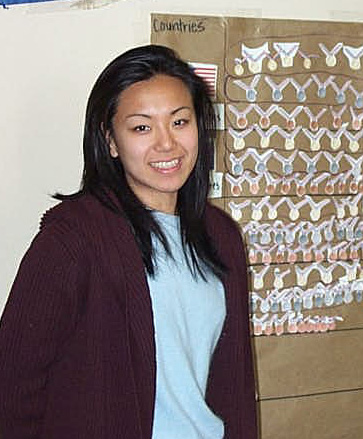
Rosemarie Young is a teacher in P.S.1M of the
New York City Public
Schools' Community School District Two in Manhattan. She has taught first
graders and third graders. She is an avid gardener and often tested her
"Flower Power" project ideas before implementing them in her classroom. She
also get many ideas by searching on the Internet. Currently, she is doing
research on tadpoles and frogs to prepare for her next project.
Subjects:
Science and Arts
Estimated Class Periods To Complete:
10 or more
Beginning Grade
Level:
3
Ending Grade Level:
6
e-mail Rosemarie
|